- 0
- 1,028 word
Your filter runs eight hours a day. The water looks clear when you look at it from the deck. But if you dive down and run your hand along the floor behind the ladder, you will feel it: a fine layer of silt that the circulation never touches.
Every pool has dead zones. Corners where the return jets do not reach. Steps where debris settles into the crevices. The deep-end floor, where the heaviest particles collect because the water barely moves down there. No amount of pump runtime or chemical balancing will physically remove dirt from a surface that the water cannot reach.
This is the gap that robotic cleaners were designed to fill. Not as a replacement for your filter, but as a physical cleaning tool that goes where water flow alone cannot.
The Dead Zones Every Pool Has
Circulation in a swimming pool follows a predictable path. Water is drawn in through the skimmer and main drain, passes through the pump and filter, and returns through the jets. In theory, this loop covers the entire pool. In practice, it misses a surprising amount of surface area.
Return jets are typically mounted on one side of the pool, which means the water flows in a directional loop. The center of that loop gets excellent circulation. The edges, particularly the corners opposite the returns, get almost none. Debris that lands in those corners stays there until you physically remove it.
The problem is worse in pools with complex shapes. Freeform pools, L-shaped pools, and pools with attached spas all have areas where circulation is weak. Even rectangular pools suffer from dead spots behind ladders, under diving boards, and along the wall beneath the skimmer.
Brushing helps, but only if you brush those spots every few days. Most pool owners brush the walls and floor they can easily see and reach, skipping the awkward angles. Over time, the missed areas accumulate biofilm, which becomes a breeding ground for algae.
How a Robotic Cleaner Covers What the Pump Misses
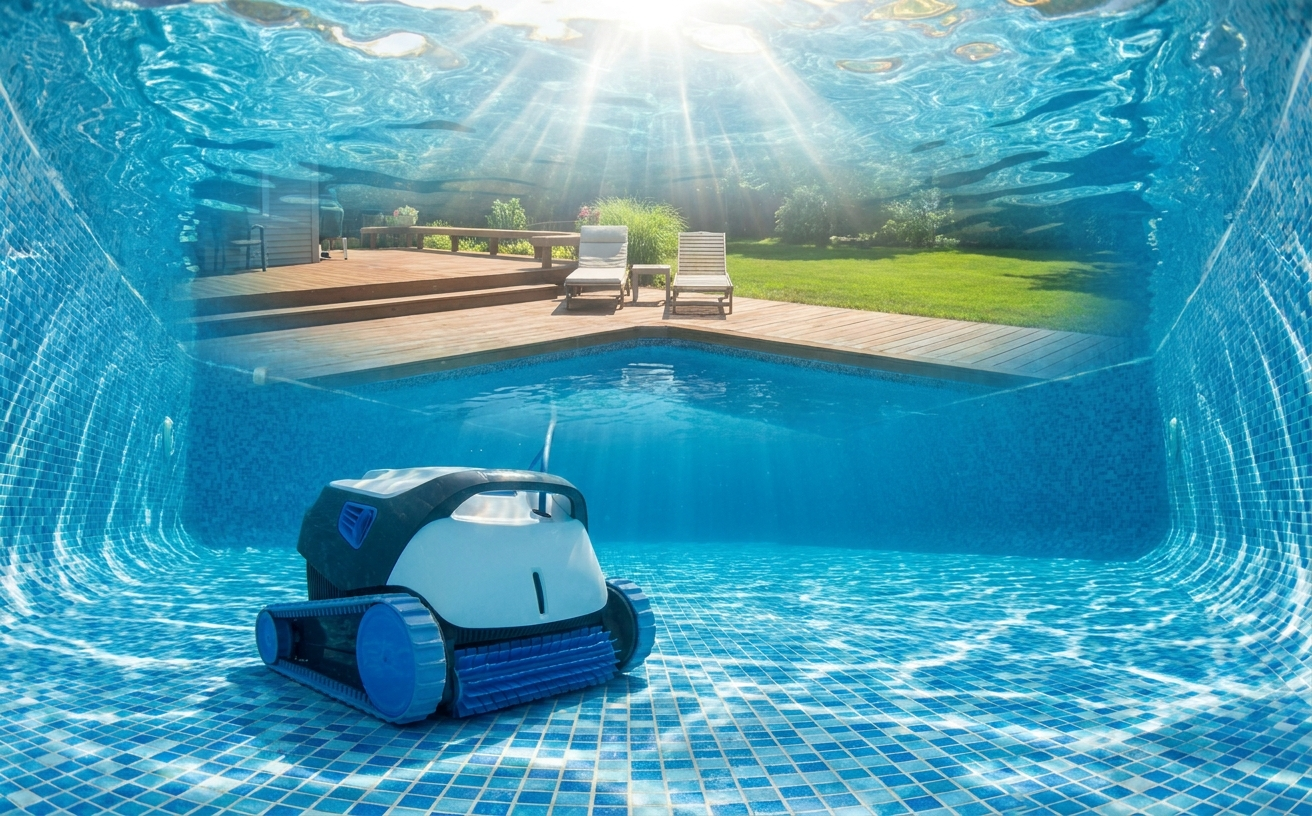
A robotic cleaner does not rely on your pool’s circulation at all. It moves independently across the floor and walls, driven by its own motor and guided by its own navigation system. Where the water goes, and where it does not, makes no difference to the robot.
This independence is what makes it effective against dead zones. The cleaner drives right into the corners that circulation never reaches. It scrubs the floor beneath the ladder. It climbs the walls behind the return jets. It covers the surfaces that your filter simply cannot touch.
Inside the cleaner, a separate pump draws water through a filter cartridge that captures debris down to very fine particle sizes. The filtered water is expelled back into the pool, creating a small localized current that helps pull nearby debris toward the intake. This means the cleaner is not just cleaning where it drives, but also pulling in particles from the surrounding area.
For anyone weighing whether a robot makes sense for their pool, a robotic pool cleaner guide that covers features, sizing, and maintenance can help you match the right model to your specific pool shape and debris load.
Why Manual Vacuuming Is Not Enough
Manual vacuuming works, but it has limits. You can see and reach most of the pool floor with a vacuum head on a telescoping pole, but the awkward spots are exactly where you tend to rush through. Behind the ladder. Under the light. The deep end corner furthest from the deck.
Manual vacuuming also depends on your schedule and your motivation. Miss a week because you are busy, and the debris starts decomposing. Decomposing debris consumes chlorine, raises phosphate levels, and creates the conditions for algae to take hold. It is a slow cascade that starts with a skipped vacuum session.
A robotic cleaner runs on its own schedule. You set it, drop it in, and walk away. It covers the entire floor, including the spots you would skip with a manual vacuum. Consistency is the entire advantage.
What to Look for in a Floor-Focused Cleaner
Not all robotic cleaners are equally good at covering dead zones. Some are designed primarily for wall climbing, with large wheels that move fast but skip over fine debris on the floor. Others prioritize floor coverage with active scrubbing brushes and a slower, more methodical pattern.
If dead zones are your main concern, focus on models with these features.
- Active scrubbing brushes that physically dislodge biofilm from surfaces
- A low clearance intake that pulls debris from tight corners and crevices
- Smart navigation that maps the pool and avoids repeating the same path
- Fine filter cartridges rated for particles under five microns
Models with only passive suction and no active brushes tend to glide over biofilm without removing it. The debris that is loosely settled gets picked up, but the stuff that is stuck to the surface stays behind.
Running a Robot Efficiently
Most robotic cleaners need about two hours to cover an average residential pool floor. Running the cleaner two to three times per week during the swimming season keeps dead zones from accumulating anything at all.
After each cycle, remove the cleaner from the pool and rinse the filter cartridge. A clogged filter reduces suction and leaves debris behind. It takes about two minutes, and it makes a significant difference in the quality of the next cleaning cycle.
If your pool gets heavy leaf fall or sits near trees, you may want to run the cleaner more frequently during peak debris season. The robot handles leaves better than most manual vacuums because it chops them up in the intake and captures the pieces in the filter bag.
The combination of good circulation from your pump, balanced chemistry, and a robotic cleaner that physically scrubs the surfaces your filter cannot reach gives you the cleanest possible water with the least manual effort. Each part handles what the others cannot.
A filter keeps the water clear. Chemistry keeps it safe. But only physical contact removes the debris that settles where the water does not move. That is the job a robot does better than anything else.
Author

henryjoseph00091@gmail.com
Related Posts

Discovering the Georgia Institute of Technology address: A Complete Guide
- 0
- 1,154 word
Are you dreaming of becoming a student at a top school? Many people look for the Georgia Institute of Technology address to...
Read out all
Understanding Modern Lash Technologies: Trends & Tips for 2026
- 0
- 1,151 word
The world of beauty changes very fast. Today, lash technologies are better than ever before. These new tools and methods help people...
Read out all
Techslassh.com: Your Simple Guide to the Future of Technology
- 0
- 1,865 word
Hey there! Have you ever wondered what the world will look like in ten years? Technology changes so fast these days. One...
Read out all
How Certified iPhone Repair Technicians Ensure Safe and Effective Device Restoration
- 0
- 447 words
As iPhones become more advanced, repairing them requires a higher level of skill, precision, and technical knowledge. Certified technicians play a crucial...
Read out all
Stay Updated with the Latest Tech News Feedcryptobuzz Trends in 2026
- 0
- 2,264 words
Hello there! It is so nice to have you here. If you are someone who loves gadgets, computers, or digital money, you...
Read out all
How Specialized Research Can Launch Your Dream Career
- 0
- 811 words
In the competitive landscape of the 2026 American workforce, the bridge between academic theory and high-level professional success is narrower than ever....
Read out all